Excited to Know More: Exclusive Solar Eclipse Planets
Explore the ultimate guide to solar eclipse planets. Find thrilling ways to watch, learn surprising facts, and enjoy a truly unique event.

Written by By Hanish Bagga
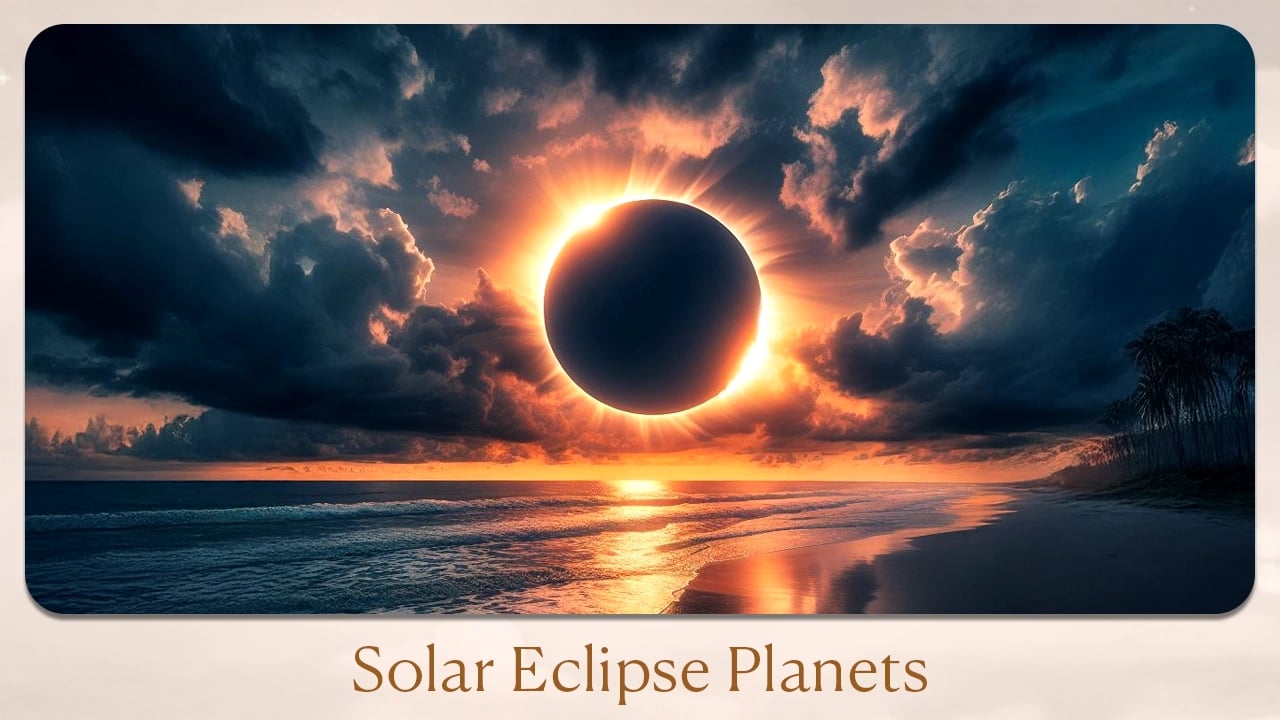
Introduction to Solar Eclipse Planets
Have you ever found yourself gazing up at the sky, heart pounding with excitement, as the world around you dims and the sun seems to disappear? That’s the magic of a solar eclipse—a cosmic event that has fascinated humans for millennia. But did you know that planets play a unique role in these celestial shows? Buckle up, because we’re about to embark on a journey through the wonders of solar eclipses and their exclusive planetary connections!
Read Also: Unlocking the Secrets of Mulank Numbers for Perfect Compatibility
What is a Solar Eclipse?
A solar eclipse occurs when the Moon passes between the Earth and the Sun, casting a shadow on Earth and temporarily blocking the Sun’s light. It’s like nature’s own blackout curtain, but with a twist of cosmic drama.

Types of Solar Eclipses
Total Solar Eclipse
This is the showstopper. During a total solar eclipse, the Moon completely covers the Sun, turning day into night for a few breathtaking minutes. The sky darkens, stars twinkle, and the Sun’s corona—a halo of plasma—becomes visible.
Partial Solar Eclipse
Here, the Moon only covers a part of the Sun. It’s like someone taking a bite out of a cookie—the Sun looks crescent-shaped, but it never fully disappears.
Annular Solar Eclipse
In this case, the Moon is a bit farther from Earth and appears smaller. It doesn’t cover the Sun entirely, leaving a “ring of fire” around the edges. It’s a sight that’s both eerie and beautiful.
Hybrid Solar Eclipse
This rare type shifts between total and annular along its path. Depending on where you are, you might see a total eclipse or just the fiery ring.
The Science Behind Solar Eclipses
The Dance of the Sun, Moon, and Earth
Solar eclipses are all about perfect alignment. The Sun, Moon, and Earth must line up just right—an event called “syzygy.” Imagine three dancers moving in sync; if one steps out of line, the show doesn’t go on.
Why Don’t Eclipses Happen Every Month?
You might wonder, “If the Moon orbits Earth every month, why aren’t there monthly eclipses?” The answer lies in the Moon’s tilted orbit. Most of the time, the Moon passes above or below the Sun from our viewpoint. Only when everything lines up perfectly do we get an eclipse.
Solar Eclipse Planets : The Exclusive Connection
How Planets Influence Solar Eclipses
While the Moon is the main actor in a solar eclipse, the planets are like supporting cast members. Their gravitational pull can subtly affect the Moon’s orbit, influencing the timing and path of eclipses. Sometimes, planetary alignments can even make eclipses more spectacular.
Planetary Alignments During Eclipses
Occasionally, a solar eclipse coincides with a rare planetary alignment. Imagine witnessing an eclipse while several planets line up in the sky—a true cosmic jackpot! These events are rare but unforgettable, offering a double dose of astronomical wonder.
Historical Significance of Solar Eclipses
Ancient Beliefs and Myths
Solar eclipses have always sparked awe—and sometimes fear. Ancient cultures saw them as omens, messages from the gods, or battles between celestial beings. In China, people once believed a dragon was devouring the Sun!
Eclipses in Modern Science
Today, we know eclipses are natural events, but they still inspire curiosity. Scientists use them to study the Sun’s corona, test theories, and even discover new planets.
Upcoming Solar Eclipses: Dates and Viewing Tips
Best Places to Witness the Next Solar Eclipse
Planning to catch the next big show? Some of the best spots are along the “path of totality”—a narrow strip where the total eclipse is visible. Check NASA’s eclipse maps to find your perfect viewing location.
Safety Tips for Viewing
Never look directly at the Sun without proper protection! Use certified eclipse glasses or solar viewers. Regular sunglasses won’t cut it. For photographers, solar filters are a must.
Read Also: Best Astrologer in Hyderabad
Solar Eclipses and Astrology: What Do the Planets Say?
Astrological Interpretations
Astrologers believe solar eclipses mark powerful new beginnings. When planets align during an eclipse, they say it amplifies the event’s energy, bringing transformation and change.
Impact on Zodiac Signs
Depending on where the eclipse falls in the zodiac, it can affect different signs in unique ways. Some may feel a surge of creativity, while others experience emotional breakthroughs.
Famous Solar Eclipses in History
The 1919 Eclipse and Einstein’s Theory
The 1919 solar eclipse was a game-changer. Scientists used it to test Einstein’s theory of general relativity, confirming that gravity bends light. It was a “lightbulb moment” for modern physics!
The Great American Eclipse of 2017
Millions across the U.S. witnessed this spectacular event. It brought people together, inspired awe, and reminded us of our place in the universe.
How to Photograph a Solar Eclipse
Essential Equipment
You’ll need a camera with manual settings, a sturdy tripod, and a solar filter. Don’t forget extra batteries and memory cards—you’ll want to capture every moment!
Tips for Stunning Eclipse Photos
Practice before the big day. Use a remote shutter to avoid camera shake. Experiment with different exposures to capture the Sun’s corona and the dramatic sky.
Solar Eclipses and Space Exploration
Eclipses as Opportunities for Research
Eclipses offer a rare chance to study the Sun’s outer layers. Scientists launch balloons, rockets, and even satellites to gather data during these brief windows.
Eclipses from Other Planets
Imagine watching a solar eclipse from Mars or Jupiter! While the mechanics are similar, the views are out of this world—literally. Moons like Phobos and Deimos create their own unique eclipses on Mars.
The Emotional and Spiritual Impact of Solar Eclipse Planets
Personal Reflections
Many people describe feeling a deep sense of connection during an eclipse. It’s a reminder of the universe’s vastness—and our small but significant place within it.
Cultural Celebrations
From festivals in India to gatherings in the U.S., solar eclipses bring people together. They’re moments of shared wonder, bridging cultures and generations.
Common Myths and Misconceptions
Some believe eclipses are dangerous or bring bad luck. In reality, they’re safe to watch with proper precautions and have no mystical powers—just scientific marvels!
Preparing for the Next Solar Eclipse
What to Pack
Bring eclipse glasses, a camera, snacks, water, and a comfy chair. Don’t forget sunscreen and a hat—waiting for the eclipse can mean hours in the sun.
Planning Your Eclipse Adventure
Arrive early to snag a good spot. Check the weather forecast, and have a backup plan in case of clouds. Most importantly, relax and enjoy the show!
The Future of Solar Eclipse Planets
Will Eclipses Always Occur?
Eclipses won’t last forever. The Moon is slowly drifting away from Earth, so in about 600 million years, total solar eclipses will be a thing of the past. Enjoy them while you can!
How Eclipses Will Change Over Time
As the Moon moves farther away, eclipses will become less frequent and less dramatic. Our descendants may only read about them in history books.
Conclusion of Solar Eclipse Planets
Solar eclipses are more than just astronomical events—they’re cosmic reminders of the beauty and mystery of our universe. Whether you’re a science buff, a spiritual seeker, or just someone who loves a good sky show, solar eclipse planets offer something for everyone. So, the next time the Moon and Sun align, grab your glasses, gather your friends, and let yourself be swept away by the wonder of it all. The solar eclipse planets may be distant, but during a solar eclipse, the universe feels just a little bit closer.
Read Also: Vargottama Planet and your Potential in Life
FAQs of Solar Eclipse Planets
Q1:What causes a solar eclipse?
Ans: A solar eclipse happens when the Moon passes between the Earth and the Sun, blocking the Sun’s light either partially or completely.
Q2:How often do solar eclipses occur?
Ans: Solar eclipses happen at least twice a year somewhere on Earth, but total solar eclipses at any specific location are rare.
Q3:Can I look at a solar eclipse with regular sunglasses?
Ans: No, regular sunglasses do not provide enough protection. Always use certified eclipse glasses or solar viewers.
Q4:Do solar eclipses affect the planets?
Ans: While planets don’t directly cause eclipses, their gravitational influence can affect the Moon’s orbit and the timing of eclipses.
Q5:What’s the best way to photograph a solar eclipse?
Ans: Use a camera with manual settings, a solar filter, and a tripod. Practice beforehand and experiment with different exposures for the best results.
For interesting astrology-related videos, subscribe to us on YouTube