Why Shiva Didn't Save Sati: An Astrological Perspective
Discover why Lord Shiva did not save Sati through an astrological lens. Understand karmic destiny, planetary alignment, and spiritual wisdom in this deep look.

Written by By Hanish Bagga
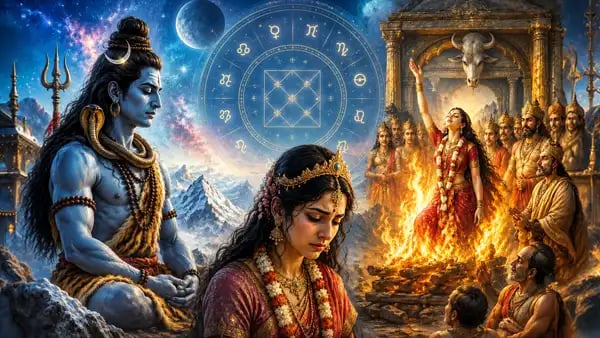
The sacred stories of cosmic history contain profound emotional weight, and none hits the heart quite as hard as the tragedy of Mata Sati. Devotees often ask with heavy hearts: why did the all-powerful Lord Shiva, the master of life and time, not step in to save his beloved wife from the sacrificial fire of King Daksha’s yajna? Was Mahadev helpless, or was there a deeper cosmic law at play?
To understand this tragedy, we must look beyond surface emotions. When we examine the ancient narrative through spiritual wisdom and cosmic planetary alignments, we uncover a profound truth about karmic destiny, cosmic balance, and divine purpose.
Why Did Lord Shiva Refuse to Prevent Sati’s Sacrifice?
The legend begins with King Daksha, father of Sati, who held immense pride and resentment toward Shiva’s modest, detached lifestyle. Daksha organized a grand sacrifice, inviting all celestial beings while deliberately excluding Shiva and Sati. Driven by love for her family and a desire to resolve the conflict, Sati insisted on attending despite Shiva’s gentle warnings.
When Sati arrived, Daksha publicly insulted Mahadev. Unable to bear the disrespect shown to her divine consort, Sati sat in deep meditation and invoked her inner yogic fire, consuming her mortal body. Shiva did not intervene because he respects the cosmic law of free will and the divine timing of karma. Even Supreme Beings do not interrupt pre-ordained destiny, as Sati’s mortal departure was necessary for her rebirth as Parvati.
How Does Lord Shiva and Astrology Explain Sati’s Fate?
In the study of Lord Shiva and Astrology, every myth reflects cosmic planetary dynamics. Sati’s sacrifice illustrates the intense interplay between ego, planetary afflictions, and spiritual transformation.
King Daksha represents an afflicted Sun, where overwhelming pride, ego, and misguided authority cloud spiritual vision. The yogic fire ignited by Sati symbolizes malefic Mars, bringing sudden intense heat, burning emotion, and ultimate sacrifice. Sati's unyielding resolve to attend the sacrifice reflects the compelling force of Rahu, driving souls toward their unavoidable karmic destiny. Meanwhile, Lord Shiva embodies the higher qualities of Saturn and Jupiter, standing for supreme detachment, absolute truth, and divine cosmic wisdom that transcends mortal life.
Daksha’s arrogance represents an afflicted Sun—where ego blinds higher judgment. Sati’s intense urge to go to the yajna, despite warnings, reflects the irresistible force of Rahu, which draws souls toward their karmic destiny. Shiva represents the supreme, detached wisdom of Jupiter and Saturn, acknowledging that earthly forms are temporary, but the soul's cosmic journey is eternal.
What Spiritual Lessons Can We Learn From This Tragedy?
The departure of Sati teaches us that attachment to temporary forms leads to suffering, while alignment with divine truth brings liberation. Even divine incarnates must fulfill their worldly roles to maintain universe balance. Sati’s sacrifice cleared the path for her rebirth as Parvati, leading to the ultimate reunion of Shiva and Shakti in a higher, indestructible form.
This story reminds us that when things fall apart in our own lives, it is often a painful clearing made by destiny to construct something far greater. Surrendering personal ego and trusting divine timing helps us navigate our personal trials with composure and faith.
How Can Sacred Worship Help Heal Karmic Obstacles Today?
When karmic debts create emotional distress, relationship friction, or unexpected obstacles, ancient Vedic rituals offer profound remedies. Performing a dedicated Rudrabhishek Puja during sacred windows helps soothe negative planetary influences, calm anxious minds, and clear karmic burdens.
For modern devotees balancing busy lives, distance no longer hinders spiritual practice. Booking an authentic Online Puja allows you to connect with experienced Vedic priests who chant powerful mantras on your behalf, infusing your life with peace and divine protection regardless of where you reside.
Why Is Sawan 2026 the Best Time for Shiva Devotion?
The upcoming holy month of Sawan 2026, starting July 30, provides a rare window of high spiritual energy. During this auspicious period, Mahadev’s divine grace is easily accessible to all who seek solace. Fasting on Sawan Somwars and offering water to the Shivling helps dissolve emotional turbulence, heal relationship wounds, and align life with divine peace.
Conclusion
The tragic story of Sati is not a tale of divine helplessness, but a profound lesson in karmic destiny and cosmic order. By understanding this story through astrology and spiritual wisdom, we learn to accept life's painful transitions with faith. Surrendering to Mahadev's divine grace allows us to transform personal trials into higher spiritual strength and lasting peace.
Frequently Asked Questions
Why didn't Lord Shiva go to Daksha's yajna with Sati?
Lord Shiva avoided Daksha's yajna because he knew Daksha's ego caused the exclusion. Shiva resides beyond honour and insult, so he advised Sati against attending uninvited. He knew uninvited guests risk disrespect, but he ultimately Honored Sati's free will when she insisted on going to her father's home.
Was Sati's death preordained according to Hindu scriptures?
Yes, scriptures indicate Sati’s earthly departure was necessary for cosmic order. She needed to shed her mortal form born of Daksha’s pride to manifest as Parvati, daughter of the Himalayas. This rebirth allowed her to unite permanently with Lord Shiva and defeat powerful cosmic demons together.
What happened after Sati consumed herself in the yogic fire?
Overcome with grief and fury, Lord Shiva created Virabhadra to destroy Daksha’s yajna. Shiva then performed the cosmic Tandava while carrying Sati’s body. To calm Shiva's rage and restore cosmic order, Lord Vishnu used his Sudarshana Chakra to cut Sati's body into 51 pieces, creating the sacred Shakti Peethas.
How does worshipping Shiva help resolve planetary defects in horoscopes?
Lord Shiva rules over time, mind, and cosmic energy, wearing the crescent moon on his head. Worshipping Shiva calms emotional distress caused by Moon afflictions and neutralizes harsh effects of Saturn, Rahu, and Ketu. Regular devotion instils mental strength, peace, and balance during difficult planetary periods.
How does Sati's rebirth as Parvati reflect the cyclical nature of astrology?
In Vedic astrology, planetary cycles (Dashas) continuously move from destruction to renewal. Sati's self-immolation and rebirth as Parvati mirror this eternal cycle, showing that painful transits or endings are never permanent. They simply pave the way for a stronger, higher alignment—just as Sati shed her mortal form born of ego to return as Parvati and reunite permanently with Shiva.