Online Kundli Matching vs Traditional Matchmaking (2026 Guide)
Compare online Kundli matching vs traditional matchmaking. Learn how Ashtakoota, Gun Milan, and planetary charts impact marriage compatibility.

Written by By Hanish Bagga
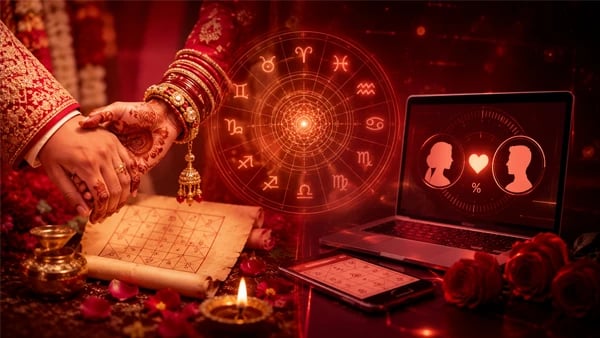
When two people decide to build a life together, evaluating long-term harmony is a central priority in many cultures. In Vedic astrology, checking prospective charts has guided families for generations. Today, technology offers instant compatibility reports at the click of a button. However, many individuals wonder how Online Kundli Matching vs Traditional Matchmaking compares when making one of life's most significant decisions.
Automated software delivers quick numerical summaries based on birth details, while human astrologers examine complex planetary alignments, individual life periods, and subtle chart nuances. Understanding how both approaches operate helps couples navigate relationship compatibility with clarity rather than anxiety.
If you are exploring chart compatibility for the first time, learning about core Kundli Matching principles offers a strong baseline before evaluating automated tools or booking a consultation.
Is Online Kundli Matching as accurate as traditional matchmaking?
Online Kundli matching provides an accurate mathematical calculation of the 36-point Ashtakoota system (Gun Milan) based on Moon positions. However, it cannot evaluate complex astrological factors like 7th house strength, Navamsa (D9) charts, Dasha timing, or Dosha cancellations.
Which method is better for marriage compatibility?
Online matching is an excellent preliminary screening tool. Traditional matchmaking by an experienced human astrologer is significantly better for final decision-making, as it analyzes overall chart health, emotional longevity, and subtle planetary interactions that software ignores.
What Is Online Kundli Matching?
Online Kundli matching is the automated generation of a relationship compatibility report using web applications or mobile algorithms. Users input birth dates, exact birth times, and locations into a digital portal.
The software translates these inputs into astronomical coordinates, plots Moon positions, and runs an automated calculation—primarily centered on the 36-point Ashtakoota framework. Within seconds, the user receives a total compatibility score along with static, pre-written explanations.
What Is Traditional Matchmaking?
Traditional matchmaking in Vedic astrology is a comprehensive, personalized analytical process conducted by a trained human astrologer. While an astrologer may use software to draw the initial planetary charts accurately, the evaluation itself relies on human synthesis.
Rather than stopping at a single score, a traditional astrologer examines both birth charts side by side. They analyze overall horoscope health, planetary strength, divisional charts like the Navamsa (D9), operating planetary periods (Dashas), and how both individuals' energies interact across various life dimensions.
Understanding these broader patterns is essential across all branches of Marriage Astrology, where a single metric never overrides the total picture of two intersecting life paths.
How Does Online Kundli Matching Work?
Online tools rely strictly on algorithmic logic based on the Ashtakoota system, measuring compatibility across eight specific categories totaling 36 points:
- Varna (1 Point): Mental ego and spiritual inclination.
- Vashya (2 Points): Mutual attraction and dynamic balance of control.
- Tara (3 Points): Birth star affinity and health potential.
- Yoni (4 Points): Instinctive and physical compatibility.
- Graha Maitri (5 Points): Psychological friendship and planetary ruler harmony.
- Gana (6 Points): Temperament, social behavior, and nature.
- Bhakoot (7 Points): Emotional connection, family welfare, and economic stability.
- Nadi (8 Points): Physiological compatibility, genetic health, and progeny.
The software checks natal Moon positions for both partners and retrieves a fixed score from a lookup matrix. If a rule triggers a conflict, it flags a generic alert like "Nadi Dosha Present".
How Does Traditional Vedic Matchmaking Work?
Traditional Vedic matchmaking uses the Ashtakoota score merely as an initial data point. An experienced practitioner approaches the charts systematically through multi-layered analysis.
First, the practitioner evaluates each person's horoscope independently to measure personal stability and emotional resilience. Next, they examine the 7th house—which governs primary partnerships—along with its sign ruler and aspecting planets. Key significators like Venus (romance) and Jupiter (stability) are analyzed thoroughly.
Finally, the astrologer reviews the Navamsa Chart (D9) to understand post-marriage dynamics, while synchronizing operating planetary periods (Dashas) over coming decades to ensure complementary life phases.
When evaluating emotional bonds or prospective partners in romantic contexts, exploring Love Astrology techniques can also clarify how emotional attraction translates into long-term commitment.
Key Differences Between Online and Traditional Methods
When comparing automated matching engines to human analysis, the fundamental distinction lies in calculation versus synthesis. Digital engines execute mathematics brilliantly but cannot assess context or counterbalancing planetary factors.
In terms of accuracy, online systems excel at providing quick mathematical Ashtakoota totals, whereas human astrologers deliver comprehensive accuracy regarding real-world relationship longevity. Human experts interpret the chart contextually, while software relies on static scripts.
Digital applications lead in convenience by providing instant access. However, in terms of analytical depth, online reports remain surface-level by focusing primarily on Moon signs. Traditional consultations evaluate multiple layers—including the Lagna, Navamsa (D9), house lords, planetary aspects, and active Dashas—making human analysis essential for final decisions.
Advantages and Limitations
Automated matching offers speed and efficiency for families reviewing numerous matrimonial profiles, filtering out clear astronomical mismatches without cost. However, online tools suffer from an over-reliance on Moon positions, ignoring the Sun, Mars, Venus, Saturn, and the ascendant. They frequently trigger false alarms and treat planetary placements as absolute fate.
A traditional consultation delivers a holistic assessment instead of reducing a human bond to a single integer. An experienced practitioner knows cancellation conditions (Dosha Bhang) that neutralize computerized warnings regarding Nadi or Bhakoot afflictions. This is vital when assessing feared chart placements like Mangal Dosha, where automated systems issue false alarms without checking for natural chart counterbalances.
The main limitation of traditional matchmaking lies in skill variation among practitioners, making it important to consult trusted, ethical professionals.
Can Online Matching Replace an Astrologer?
No. Online tools cannot replace an experienced astrologer for final decision-making, just as a health calculator cannot replace a physician.
An automated program executes pre-programmed logic rules and cannot synthesize conflicting data points. For example, if an online tool calculates a low score of 14 out of 36 due to Bhakoot afflictions, it labels the union unacceptable.
However, a human practitioner studying those same charts might discover that both partners have exceptionally strong 7th house lords, well-placed Venus positions, and complementary Dasha periods that completely override the Moon-based friction.
For couples navigating modern dating or pre-marital choices, evaluating broader Relationship Compatibility factors with a human expert provides actionable clarity beyond basic numerical scores.
How Accurate Is Gun Milan Alone?
Evaluating Gun Milan in isolation provides only a partial view of overall compatibility. High scores do not guarantee immunity from divorce, nor do low scores doom a partnership to failure.
Statistical experience reveals that couples with exceptional scores (e.g., 30+/36) can still experience distress if their 7th house, 8th house (intimacy), or 12th house are severely afflicted. Conversely, couples scoring below 18 points often enjoy thriving marriages when their overall natal charts demonstrate high emotional intelligence and mutual planetary support.
If you entered a relationship through a romantic bond rather than an arranged introduction, reviewing factors specific to Love Marriage Astrology helps ensure that romantic chemistry is backed by planetary stability over time.
Common Misconceptions
A common misconception is that receiving a score below 18 means a couple must break up immediately. In reality, a low score simply indicates that Moon signs share fewer baseline traits; it does not measure personal maturity or conscious effort.
Another myth is that online tools automatically detect all cancellations. Modern algorithms flag doshas based on basic positional rules without evaluating complex exception conditions outlined in classical texts.
Finally, many believe a score of 32 out of 36 guarantees a conflict-free marriage. A high score only reflects alignment in Moon-related traits and cannot shield a couple if individual charts show severe planetary afflictions in core relationship houses.
Conclusion
When comparing Online Kundli Matching vs Traditional Matchmaking, both serve clear purposes. Online tools offer speed and convenience for initial screening. However, automated scores lack the depth, context, and nuance required to evaluate a lifelong marriage. Combining digital calculations with the wisdom of an experienced practitioner ensures couples move forward with clarity and confidence.
If you are planning to take the next step in your relationship and want a complete evaluation beyond basic automated scores, consider booking a personalized review with a qualified expert to analyze your birth charts, Navamsa details, and planetary periods with complete peace of mind.
Frequently Asked Questions
Is online Kundli matching accurate?
Online Kundli matching is mathematically accurate for calculating the 36-point Ashtakoota score based on Moon positions. However, its overall accuracy for relationship longevity is limited because software cannot analyze planetary strength, house lords, Navamsa charts, or planetary periods (Dashas).
Is Gun Milan enough for marriage compatibility?
No, Gun Milan alone is not sufficient to judge marriage compatibility. It measures only Moon sign and star alignments. Crucial factors like 7th house health, Jupiter and Venus placements, Dasha timelines, and Dosha cancellations are omitted from a standard Gun Milan score.
Which is better: online Kundli matching or traditional matchmaking?
Online matching is better for initial, quick screening when sorting through profile options. Traditional matchmaking by a human astrologer is vastly superior for final decisions, as it offers a holistic, nuanced evaluation of both horoscopes, potential challenges, and long-term timing.
Can online Kundli matching replace an astrologer?
No, online Kundli matching cannot replace an experienced astrologer. Software runs static algorithms and often flags false-positive doshas. An astrologer synthesizes complex chart interrelationships, identifies cancellation rules, and provides tailored guidance.
What should be checked besides Gun Milan?
Beyond Gun Milan, a complete astrological evaluation must check the strength of the 7th house and its ruler, the Navamsa (D9) chart, Venus and Jupiter placements, upcoming Dasha sequences, and the presence or cancellation of planetary afflictions like Manglik or Nadi Doshas.